


Welcome back to Green Building 101. In our last post, we touched upon how to select an environmentally responsible location for your new abode, and in this piece, we’ll begin to discuss ways you can improve upon any home site. The “Sustainable Sites” section of USGBC’s LEED for Homes program outlines various “green” opportunities for reducing the negative impact your home has on the environment. Most of these principles can be implemented at any time, whether you’re still in the design process or if you’ve been in your home for years. Here are a few measures you can take to create a more sustainable site:


Time and Nature Have Sculpted Your Land: Consider This an Asset
Most importantly, use what nature has given you by working with existing topography, plants, and views. Touch the earth lightly, rather than cutting deep and covering it with concrete. (If you bought the land to scrape it, you might as well be building on a K-Mart parking lot.) As an example, the eco-friendly Tinbeerwah House in the Australian Noosa Hinterland, shown above: the home was constructed on top of a unique grid system of steel portal frames that elevate it above a steep slope in order to minimize site disturbance.

Vegetation is Good; Native Vegetation is Better
Landscaping is a critical component to the livability of any home, but people often optimistically misjudge the viability of plants. First, make an effort to preserve any existing native plants, as they obviously like where they’re living and can possibly be groomed into a low-maintenance greenscape. Second, work with a local gardening supply store (not a Big Box) to help you select plants that will grow best with your local climate and soil conditions, thus reducing the need for excessive watering. Third, seek out organic options for fertilizer and herbicides/pesticides to prevent any longterm negative impact in the local ecosystem and water table.
Related: Los Angeles Pays Residents to Rip Out Their Lawns

Shade, Shade, Shade
Your driveway, sidewalk, and paved terrace all absorb the sun’s rays during the day, storing it like a battery, and radiating that energy back—even at night. These “hardscapes” form microclimates of hot air pockets that are not only miserable for people, but take a huge toll on the cooling bill of any nearby building. At the city scale, dense collections of hardscape add up to a lot of heat known as the urban heat island effect, so the more you can keep these areas shaded, the better off you (and your city) will be. Think trees, pergolas and canopies—oh my!

For you advanced players in the heat dissipating game, there’s no place left to go but up: Green Roofs!! Here at Inhabitat, our love of green roofs runs a close second only to prefabricated buildings. There is a huge variety of green roof construction systems to fit nearly every building type and location. Stay tuned to Inhabitat for more on greening your roof in the near future.

Where is Your Water Going?
Maybe you’re not yet ready to capture and recycle rainwater, but any precipitation that isn’t soaked up by your lawn runs straight into your city’s storm water system. While this is a natural thing for water to do, it nevertheless picks up things like oil, antifreeze, fertilizer, and pesticides that may have accumulated in your yard or driveway, contaminating the water system and contributing to erosion. You can reduce this negative environmental impact simply by directing run-off from driveways and gutters towards your lawn, and providing enough of a depression for the grass to hold the rainwater longer, allowing it to filter naturally through the soil.
Not All Bugs are Bad!
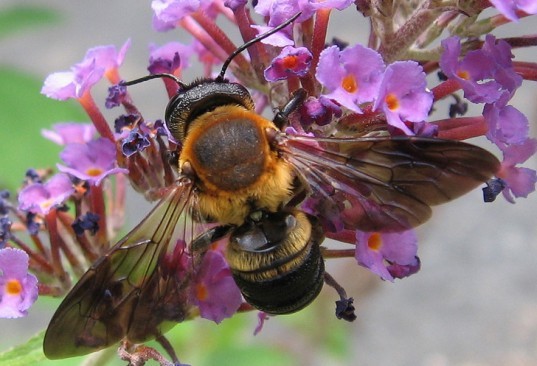
Rather than spreading poison to eradicate pesky aphids from your tomato plants, consider some of the alternatives. Organic pest control has finally become widely available, so in addition to homemade sprays made with glycerin and essential oils, nematodes, diatomaceous earth, and orange peels are just a few of the ways you can fight insects without chemicals. Your local garden supply stores should be able to help you choose a product for your specific problem, and doing a bit of research on organic methods of pest control can’t hurt either! Remember thatinsecticides affect beneficial insects too, and with the startling decline of bees around the world, it’s better to be safe and gentle to your garden rather than risk killing any more of them off.
Related: Attracting Pollinators – Plants that Encourage Bees, Butterflies, and Birds to Visit
Our next piece will focus specifically on water conservation, both inside and outside the home, so stay tuned!


