Anybody remember the launch of C2C Home a couple of years ago? It was an open competition for residential design using the values of sustainability set forth by William McDonough’s Cradle to Cradle philosophy. We were highly anticipating the futuristic housing that would emerge through the collaboration of forward thinking developers, talented designers, and dedicated contractors striving to reduce our living footprint. Having heard little in the last two years, we were thrilled to learn that the first Cradle-to-Cradle house is nearing completion in Roanoke, Virginia.
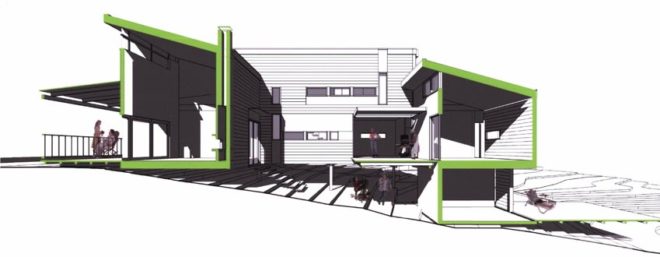
So which entry was chosen? And what fabulous design is about to materialize as a monument to the principles of sustainable living? Here’s a hint: the competition winner (pictured above) will not get that particular honor………


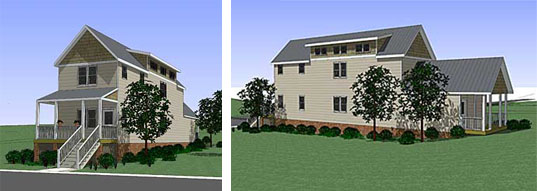
The design by local architects Stephen Feather and Richard Rife (above) has been chosen from the 624 other entrants in the competition as the inaugural project to be built. While it was not a winning entry, it seems that the city of Roanoke, in which the competition was sited, has gone forward with construction plans. We had hoped that the design of this first model would be more aesthetically inspiring, although we commend the integration of renewable energy systems, such as the geo-thermal heat pump and solar panels, in such a modestly priced home: construction costs are expected to be around $150,000, much of that being subsidized by a local community development corporation.
However, the question begs to be asked; why was this model chosen for construction over one of the winners? Of course, we encourage sustainable development however it happens. But is this the best representative of innovation in sustainable systems, technologies, design, and living? The latest news offered on C2C’s website is that a ceremonial groundbreaking was held in May of last year for up to eight of the entrants. C2C notes that plans for two (non-winning) entries are in the works – neither of which are Feather and Rife’s, which make this all the more puzzling. Most likely, Feather and Rife’s entry was simply the easiest to construct, generically palletable, and the least scary from a public funding standpoint. Baby steps, right?
We would love to know what the status is of the winning projects – if they are going to be built, how the funding will be procured, and what the timetable might be. If these winning entries are being disregarded in lieu of other participants, what was the point in honoring them in a competition about building homes sustainably? The irony is that 600 design teams worked their butts off “burning the midnight oil,” plotting test prints, building models, and shipping their work – to be judged on how effectively it minimizes waste and uses resources responsibly!
Too often, competitions prove to be a fruitless publicity stunt to raise money for under-funded institutions or image hungry developers. Considering the approachable scale and high profile of the first Cradle to Cradle home, we thought surely one of the winners would see light of day. Hopefully someone close to the competition can update us on why the winners have been sidelined.
+ C2C Home Competition